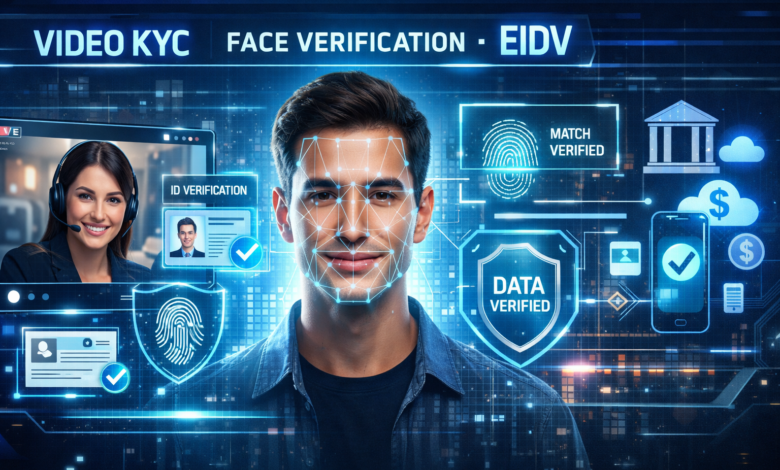
The expectations of the customers have changed radically in the digital era. Consumers no longer desire stressed paperwork, attending branches numerous times, and tedious onboarding procedures to register in financial services. Meanwhile, business organizations are experiencing an increasing demand to meet the stringent requirements of the KYC (Know Your Customer) and AML (Anti-Money Laundering) policies. This demand and adherence have driven Video KYC to the top of the modern identity verifications solutions.
Video KYC is an identity verification method that enables companies to identify their customer remotely through live video communication, face recognition and Electronic Identity Verification (EIDV) system. Through a mix of human control and automation afforded by AI, Video KYC provides a customer-friendly, fast, and secure experience lowering the friction and making sure that regulatory standards are met.
Understanding Video KYC
Video KYC this approach to authentication verifies a person with the help of the live video session instead of the physical appearance as in the case of traditional authentication. In the process, a customer provides documents issued by a government, including a passport, driving license, or national ID and a trained agent or a machine-based artificial intelligence system will cross-check the information.
Face verification is a technology where the customer has to be checked using their real face and the document photo to ensure the customer is genuine. EIDV, in the meantime, supplements the validation with checking the identity with government or authorized databases that minimizes fraud and ensures the correctness of the information submitted. The resultant effect of this biometric verification and electronic verification is a strong, secure, and scalable identity verification process.
See also: Advancements in Bonding Technologies for Modern Manufacturing
The Reason Why Video KYC is becoming popular
There are a number of reasons why Video KYC can be adopted so fast by industries. Obvious is the most common one called convenience. The process of customers undergoing the process of verification can also be done anywhere through the use of smartphones, laptops, or tablets. This will help in eliminating the physical visits to physical branches or the submission of physical documents.
In the case of businesses, Video KYC saves business expenses and improves compliance. All verification sessions are tracked and kept in a digital format which gives a clear audit trail in order to meet regulatory requirements. A better level of fraud prevention is also guaranteed since both biometric verification, Liveness detection, and EIDV ensure that there is no identity theft, deep fake, or document forgery.
The move to digital banking, online investments, and fintech platforms is another force that has driven the need to use Video KYC. It provides organizations with a competitive edge by providing better onboarding experience, which is faster, safer, and smoother, which results in higher customer satisfaction and loyalty.
How Video KYC Works
The Video KYC starts when a customer starts a video session. The system directs the user through the submission of documents and at the same time face confirmation is done. Advanced sites use EIDV, which compares the information on identity with the official value databases to verify authenticity.
Artificial intelligence algorithms can improve the process by revealing inconsistencies, authenticating document integrity and liveness, preventing spoofing, or deep fake attacks. When verified, the system stores the information safely and renews the profile of a customer allowing him or her to access services instantly.
This not only minimizes the time of onboarding as well as the complexity of onboarding but it also improves security since real time verification reduces chances of fraud.
Video KYC Across Industries
Video KYC was originally used in the banking industry and the financial services sector; however, today, it is being applied to insurance companies, telecoms, digital wallets, and gig economy applications. It is used by insurance companies to check applicants and claims are done efficiently. Telecom operators are incorporating Video KYC as a way of turning on SIM cards as well as eliminating subscription fraud. Even markets and freelance sites are capitalizing on this technology to guarantee trust among the user and the service providers.
Video KYC is the best solution to any industry where identity verification is highly needed due to its flexibility and scalability. Along with regulatory compliance requirements (e.g. GDPR and AML), Video KYC allows businesses to grow online without loss of security.
Innovations and Future Trends
Video KYC is a technology that keeps on developing. Face verification hast been advanced by AI systems that are now more precise in terms of accuracy and fraud detection. EIDV integration provides almost real-time verification with various authoritative data, significantly shortening the onboarding process.
Another significant trend is mobile-first design. As smartphones become the new device of accessing digital services, the companies are streamlining the Video KYC platforms to work on the mobile platform, making sure that the video quality is of high resolution, that document scans are real-time, and interfaces are user-friendly.
Also, the use of Video KYC is gradually becoming embedded in digital signature systems, secure cloud-based repositories, and identity lifecycle management platforms. This provides a digital end-to-end onboarding pathway that is flawless, secure and compliant.
Implementation Problems
Although it has benefits, the introduction of Video KYC is not an easy process. The privacy of the data is also of utmost importance because the sensitive personal data is sent and stored in the digital format. Organizations have to adhere to rigid encryption measures and international and local data protection regulations.
The reliability of the network is also an issue, and live video checking cannot be made without a stable internet connection. Firms should ensure that they come up with systems that work well even with low bandwidth conditions. Finally, regulatory compliance is also region-specific, and it is important to align EIDV and verification procedures to local KYC and AML standards.
The Future of Video KYC
Customer onboarding of the future is going to be a digital process and at the center of this is Video KYC. Face verification, EIDV, and AI can be used together to deliver secure, efficient, and user-friendly onboarding experiences by organizations.
Video KYC is set to be adopted as the future of Internet-based services in identity verification, enabling businesses to satisfy their customer demands and comply with the high regulatory standards. Those companies adopting Video KYC today not only will spend lower in terms of operations and a reduction in fraud exposure but will also establish their leadership in the digital-first world.
Basically, Video KYC signifies the new level of identity verification, where convenience, compliance, and security are simulated, forming trust in the digital economy.