Space-Saving Innovation: Why Spiral Conveyor Belt Systems Are Gaining Popularity

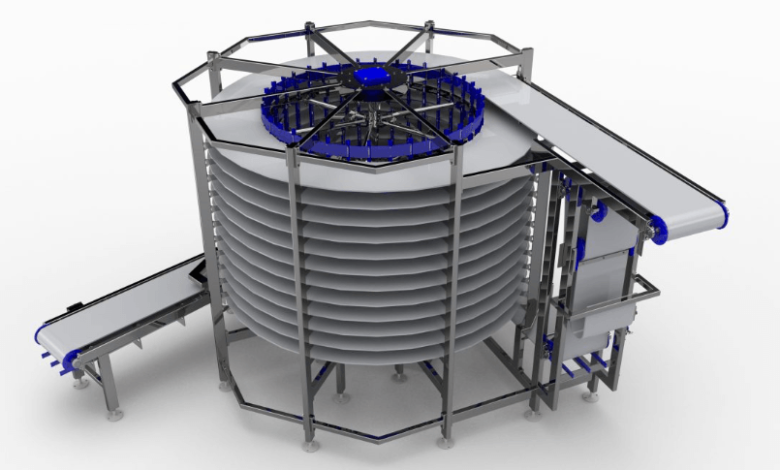
As manufacturing and processing facilities continue to evolve, maximising available floor space has become just as important as improving production efficiency. Expanding a facility is often expensive and disruptive, leading many businesses to focus on smarter equipment that delivers higher performance within a smaller footprint. Among the innovations supporting this shift, the Spiral Conveyor Belt has emerged as a practical solution for facilities looking to optimise space without compromising productivity.
Unlike conventional straight conveyor systems, spiral conveyors use a vertical design that allows products to move upward or downward while occupying significantly less floor area. This compact configuration has made them increasingly popular across a variety of production environments where efficient use of space is essential.
Making Better Use of Limited Floor Space
One of the biggest advantages of a Spiral Conveyor Belt is its ability to transport products vertically instead of relying solely on long horizontal conveyor lines. By utilising vertical space, businesses can increase production capacity without requiring additional floor space.
This approach is particularly valuable in facilities where expansion opportunities are limited or where production equipment must fit within existing layouts. The ability to integrate vertical conveying helps organisations redesign workflows more efficiently while avoiding costly building modifications.
Supporting Continuous Product Flow
Modern production relies on smooth and uninterrupted product movement between different stages of manufacturing. Conveyor systems that reduce bottlenecks contribute directly to improved operational efficiency.
A Spiral Conveyor Belt enables products to move continuously between different elevations, helping maintain a steady production rhythm. Whether transporting items from processing to packaging or connecting multiple production levels, the system supports efficient material flow while reducing unnecessary manual handling.
An Ideal Solution for Multi-Level Operations
Many manufacturing facilities operate across multiple floors or incorporate elevated processing equipment. Moving products safely between these levels can become a logistical challenge without the right conveying solution.
The vertical design of a Spiral Conveyor Belt simplifies this process by providing a continuous pathway between different heights. This reduces the need for multiple transfer points, lifts, or separate conveying systems, creating a more streamlined production layout.
Improved Workflow Efficiency
Efficient workflows depend on minimising unnecessary movement throughout the production process. Poor equipment placement or excessive conveyor lengths can increase transport time and reduce overall productivity.
By integrating vertical transportation into a compact footprint, a Spiral Conveyor Belt helps create more organised production layouts. Shorter product travel paths and fewer transfer stages can improve operational efficiency while allowing manufacturers to utilise valuable workspace more effectively.
Designed for Continuous Operation
Production facilities often operate for extended hours, making equipment reliability a critical consideration. Conveyor systems must withstand continuous use while maintaining consistent performance.
Continuous production places significant demands on conveyor systems, making long-term reliability a critical consideration. With its engineered construction, a Spiral Conveyor Belt is designed to provide consistent conveying performance while helping facilities maintain efficient operations with fewer unexpected stoppages.
Flexibility Across Different Applications
Another reason for the growing popularity of Spiral Conveyor Belt systems is their versatility. They can be adapted to transport products of various sizes, weights, and shapes across multiple production environments.
Whether used for cooling, buffering, accumulation, packaging, or general material handling, spiral conveyor systems offer flexible solutions that can be integrated into both new and existing production lines. Their adaptability makes them suitable for businesses seeking scalable conveyor solutions as operational requirements evolve.
Supporting Automation and Smart Manufacturing
Automation continues to reshape manufacturing, requiring equipment that integrates seamlessly with intelligent production systems. Conveyor technology plays an important role in maintaining synchronised workflows between automated processes.
A Spiral Conveyor Belt can be incorporated into automated production environments to facilitate consistent product movement between machinery, inspection systems, and packaging equipment. Its predictable operation supports improved coordination across production lines while helping manufacturers achieve greater process efficiency.
Long-Term Operational Value
Beyond space savings, businesses increasingly evaluate conveyor systems based on long-term performance and ownership costs. Equipment that combines durability with efficient operation often provides greater value over its service life.
A well-designed Spiral Conveyor Belt can reduce the need for complex conveyor layouts while minimising maintenance requirements and maximising equipment utilisation. These operational benefits contribute to lower lifecycle costs and improved production reliability over time.
See also: Can Foreigners Start a Business in Dubai?
Conclusion
As manufacturers continue seeking smarter ways to increase productivity within existing facilities, compact conveyor solutions are becoming an essential part of modern production design. A Spiral Conveyor Belt offers an effective way to optimise floor space, improve workflow efficiency, support automation, and simplify material handling across multiple production levels.
Selecting a high-quality conveyor system is an important investment in long-term operational performance. Industry leaders such as Wire Belt continue to develop engineered conveyor solutions that help businesses build more efficient, reliable, and future-ready production environments.