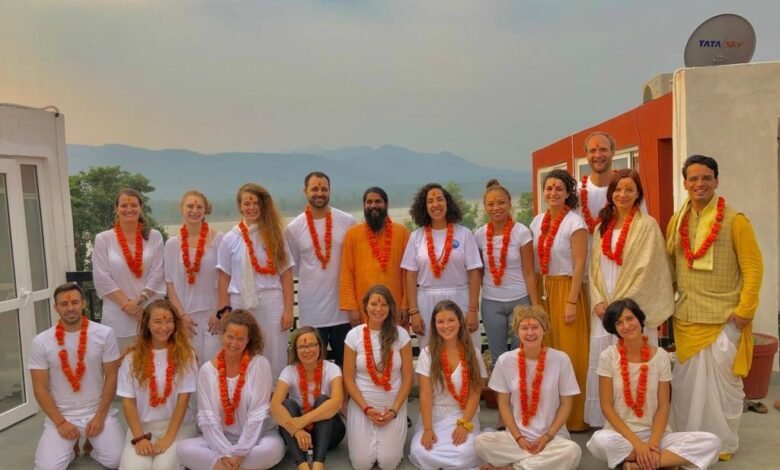
There is a quiet shift happening in the global yoga community. Students who once enrolled in weekend workshops or month-long retreats are now choosing something deeper, longer, and more transformative. Long-term immersion programs — spanning months rather than days — are attracting practitioners from every corner of the world. The question is: why?
The answer is not simply about earning a certificate. It is about becoming someone different by the time you leave.
The Limits of Short-Term Learning
Weekend workshops offer inspiration. A well-taught class can spark curiosity and open a door. But inspiration fades. Without sustained practice, the body forgets the alignment cues, the mind reverts to old patterns, and the philosophical concepts that once felt profound become vague memories.
Short-term programs, by their very nature, compress learning into a pace that suits schedules rather than human transformation. The nervous system needs time to integrate new information. The body needs repetition — not rushed repetition, but patient, daily repetition over weeks — to build genuine muscle memory and postural intelligence.
Long-term immersion addresses this directly. When a student commits to an extended program, the learning becomes cumulative. Each day builds on the last. Questions that arise on day seven are answered through practice by week four. That is the difference between knowing something intellectually and understanding it in your bones.
What “Immersion” Actually Means
The word immersion is used loosely in modern wellness marketing, but in the context of yoga education, it means something specific: total engagement with the subject over a sustained period, in an environment designed to remove distraction.
In a genuine immersion program, students wake up early for pranayama and meditation. They practice asana twice daily. They attend lectures on anatomy, philosophy, and teaching methodology. They cook and eat together. They rest. They reflect. And they do this not for a weekend, but for weeks or months.
This rhythm is not accidental. It mirrors the traditional Gurukul model of learning — an ancient educational system where students lived with their teachers and absorbed knowledge through daily life, not classroom hours alone. Many students who experience this model say it fundamentally changed how they think about learning itself.
The Rise of Yoga in India as the Gold Standard
Among immersion destinations, one country stands above the rest in both historical legitimacy and transformative depth. Yoga in India is not a trend — it is the source. India is where the system was developed, refined, and passed down through an unbroken lineage of teachers spanning thousands of years.
Practitioners who travel to India for immersion programs often describe a shift that goes beyond technique. The culture, the philosophy, the temples, the food, the daily rhythms of life in India — all of it becomes part of the educational experience. You are not simply studying yoga; you are surrounded by its living context.
Cities like Rishikesh, Mysore, Pune, and Kerala have become global centers for serious yoga education, attracting both traditional lineage holders and world-class contemporary teachers. Students who train here gain access not just to asana instruction but to the broader ecosystem that gave yoga its depth — Ayurveda, Sanskrit, devotional practice, and a community of fellow seekers from around the world.
Why Advanced Certifications Attract Serious Practitioners
For those who have completed a foundational 200-hour program and want to go further, the next step is not simply “more yoga.” It is a deepening — of understanding, of practice, and of teaching capability.
This is precisely why enrollment in 300 hour yoga teacher training in India has grown significantly in recent years. A 300-hour advanced training is not a beginner’s program. It is designed for practitioners who already have a foundation and want to develop mastery — in sequencing, in adjustment technique, in working with students with injuries or special needs, and in teaching with genuine philosophical depth.
These programs attract a particular kind of student: one who has moved past the novelty stage, who teaches or wants to teach seriously, and who recognizes that the most skilled teachers are always still students. The 300-hour format provides enough time — typically eight to twelve weeks in residency — to move through material with the care it deserves rather than rushing through topics to meet a deadline.
Six Reasons Students Are Choosing Long-Term Immersion
1. Real transformation takes time
The research on habit formation, skill acquisition, and nervous system change all point in the same direction: meaningful change requires sustained effort over time. A two-week yoga retreat can be powerful, but a two-month immersion is something categorically different. Students return home different in ways they can point to and sustain.
2. The community formed is irreplaceable
Something profound happens when a group of people commit to an intense shared experience over weeks. The bonds formed in immersion programs are routinely described by graduates as among the most meaningful of their lives. This community becomes a professional network, a support system, and often a lifelong friendship group.
3. The depth of curriculum cannot be compressed
Yoga philosophy alone — the Yoga Sutras, the Bhagavad Gita, the Upanishads, the Samkhya system — requires weeks of study to begin to absorb meaningfully. Anatomy and physiology need time for practical application. Pranayama and meditation practices deepen only through consistent daily engagement. Long-term programs honor the actual complexity of the subject.
4. Environment matters for learning
Immersion programs create a protected environment where learning is the only job. There are no emails to answer, no commutes to make, no competing demands. This focused container dramatically accelerates growth. Students in immersion settings typically report learning more in eight weeks than in years of part-time study.
5. Teaching confidence grows through practice teaching
One of the most critical elements of teacher training is the opportunity to teach — to real students, with feedback, repeatedly. Long-term programs build in extensive practice teaching hours, allowing trainees to move through the inevitable awkward phase and arrive at genuine confidence before they step into their own classrooms.
6. Personal practice reaches new depths
Beyond teaching skills, immersion students consistently report that their personal practice transforms in ways they did not anticipate. Daily practice over months changes the relationship with the body, with breath, and with stillness. Many students say the personal transformation — not the certificate — becomes the most valuable outcome.
Who Immersion Programs Are Right For
Long-term yoga immersion is not for everyone, and good programs are honest about this. These programs suit:
- Practitioners who have a stable personal practice and want to deepen it significantly
- Teachers who completed a 200-hour training and feel they have more to learn before teaching confidently
- Individuals going through life transitions — career changes, personal reinvention, recovery — who want a structured, supportive environment for inner work
- Serious students who want to study with high-caliber teachers in an uninterrupted setting
What immersion programs are not ideal for: complete beginners with no background in yoga, or those who cannot commit genuinely to the schedule and community agreements. The intensity that makes these programs powerful is also what makes them demanding.
What to Look for in a Quality Program
With the growth in demand for immersion training, the market has expanded — which means quality varies. Before committing to any long-term program, prospective students should investigate:
Teacher credentials and lineage. Who are the lead teachers? What training have they completed? With whom did they study? How long have they been teaching? Authentic expertise is not hidden — teachers with genuine depth will have a clear, traceable background.
Curriculum transparency. A quality program publishes its full curriculum, not just a list of vague promises. What specific topics are covered? What texts are studied? What is the daily schedule?
Student outcomes. What do graduates say, not in curated testimonials but in third-party reviews? Do graduates go on to teach successfully? Do they feel the program prepared them for real-world teaching?
Ethics and community agreements. Immersion programs ask a lot of students. In return, they should have clear, written policies on student welfare, grievance processes, and teacher-student boundaries.
Accreditation. For those pursuing teaching credentials, look for programs registered with Yoga Alliance or equivalent national bodies. This ensures the training hours will be recognized internationally.
A Note on Cost and Investment
Long-term immersion programs represent a significant financial investment. Tuition, accommodation, and travel — particularly for programs abroad — adds up. It is reasonable to ask whether the investment is justified.
The more useful question is: compared to what? Students who have attended multiple short workshops over several years frequently report spending comparable amounts of money while making far less progress. Consolidating that investment into a single, well-designed immersion typically produces better outcomes — both in teaching skill and in personal transformation.
Many programs also offer scholarships, payment plans, or work-study arrangements for students who demonstrate commitment but face financial barriers. It is worth asking directly.
See also: The Business Owner’s Guide to Stress-Free Payroll in 2025
The Long View
The most important thing to understand about long-term yoga immersion is that the value compounds over time. The skills, the relationships, the shifts in perspective, the deepened practice — these do not depreciate. They appreciate. Teachers who trained in rigorous immersion programs consistently describe the experience as the foundation on which their entire career rests, years or decades later.
In an era defined by impatience and abbreviated attention, choosing to go slowly, deeply, and completely into something is itself a radical act. It is, in fact, a yogic one.
For students who are ready — truly ready — long-term immersion is not just a program. It is a turning point.