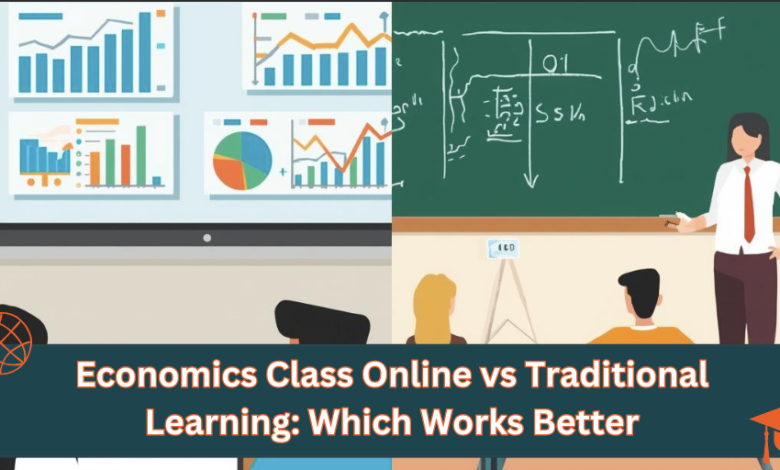
In the past few years, higher education has transformed. Students used to rely virtually on physical classrooms, printed textbooks, and fixed lecture times. The digital learning platforms have brought fresh possibilities today, particularly with those subjects that involve theory, data interpretation, and application in real life, such as economics. The question that comes up as a result of this shift is whether an online course in economics provides superior results compared to the classroom-based method of learning, or does the traditional face-to-face education still have an edge?
The two approaches possess their advantages, and the most appropriate choice is usually hinged on the lifestyle of a student, his or her learning styles, and self-discipline. The knowledge of these differences will enable the students to make the decisions regarding the use of the format that can best serve their academic objectives.
Flexibility vs Fixed Structure.
Conventional classroom education is based on strict schedules. Lectures are offered at certain times, and this may be useful to the students who are routine and externally disciplined. Face-to-face meetings also decrease procrastination and establish a definite academic pace.
Courses in economics online are more flexible than any other. The students can get access to lectures, readings, and assignments at any time. Challenging subjects such as market equilibrium or fiscal policy models, demand elasticity, etc., can be re-taken again and again. This is the self-paced format that is advantageous to the learners who have to balance their work, family, or any other commitments with their studies.
In the intense academic years, a few students will turn to such web solutions as take my economics class to relieve themselves of the pressure of work. Although these alternatives can be an effective solution in the short term, the success over the long term will still rely on the real interaction with the course content.
Student Engagement and Learning Experience.
Face-to-face classes offer instant communication with teachers and classmates. Students can ask questions in real time, engage in chats, and create an academic relationship. Such an environment would be able to make the learning process more engaging and eliminate isolation.
To a great extent, online courses reproduce this interaction in the form of discussion forums, live virtual classes, and chat communication. Moreover, the online economics classes are more visually stimulating than the traditional lectures because digital learning tools (interactive graphs, quizzes, and simulations) are frequently used.
There are those students who are more concentrated in a classroom environment and those students who are better at learning online on their own. The ultimate participation is based on individual learning style.
See also: Transforming Sleep with Advanced Technology
Availability of Resources and Study Materials.
The traditional method of learning uses campus libraries, printed books, and face-to-face academic assistance. Although it is dependable, it might be hard to access due to location and opening hours.
Through online learning, a student is able to access digital books, research journals, lectures, and academic databases from any location at any time. This unlimited accessibility is a significant strength for economics students who use reports, datasets, and case studies.
Such accessibility to the resources also promotes better research habits and more effective preparation of assignments.
Instructional Strategies and Content Presentation.
Economics is normally delivered by lecture, board work, and slide presentation in physical classrooms. This is an approach that will be good with students who like to be told what to do and systematically take notes.
Online courses are provided in the form of recorded modules, multimedia explanations, self-check quizzes, and online simulations. Students are able to stop and replay as well as repeat complicated parts. This is content control which serves to strengthen meaning and enhance retention.
Online education, however, necessitates self-discipline. In the absence of effective time management, students will be left behind. Learning in the classroom will automatically impose attendance and frequent progress.
Assessment and Feedback
Conventional courses are based on face-to-face examinations, paperwork, and presentations. It might also take longer to receive feedback, based on the grading.
Digital systems tend to have instant feedback on quizzes, digital grading, and tracking of progress. This enables the students to eliminate bad points at an early stage and rectify them before the major tests.
Both systems are capable of upholding academic integrity, and online systems offer quicker feedback mechanisms that are very useful to many students.
Academic Assistance and Support.
There are those students who need additional help as long as heavy academic workloads are involved. They can visit online class help to know what to expect in the course or how to better organize assignments. Such guidance can help to be organized and clear when applied responsibly. Nevertheless, true academic development is achieved through the development of independent problem-solving and analytical skills.
Which Learning Style is more effective?
Traditional education is effective among students who are structure-loving, face-to-face, and need to have supervision during their learning. Online learning can be applied to students who appreciate flexibility, studying at their own pace, and computer-based learning.
There are numerous universities that have blended learning models that are a combination of classroom sessions and online modules. This solution gives the framework of traditional learning and the ease offered by online learning. Feeling overwhelmed by assignments and tight deadlines, a struggling student searched online for services using the phrase take my online exam, hoping to find reliable academic support to ease the pressure. Feeling overwhelmed by assignments and tight deadlines, students look online for services using the request take my online exam, hoping to find reliable academic support to ease the pressure.
Conclusion
There is no discussion on which one is superior at all times, online or traditional learning. It concerns what format is in keeping with his or her lifestyle, duties, and learning patterns. Classroom learning provides face-to-face learning and routine. Online education provides flexibility, deep digital technologies, and learning 24-7.
Through proper study habits and motivation, students can perform well in either one of the environments. Since education has been dynamic, the most appropriate option is one that enables every learner to learn effectively, remain consistent, and develop a solid knowledge of economics.