The AI Agent Pricing Problem: Why Flat-Rate Subscriptions Break When Machines Use Them

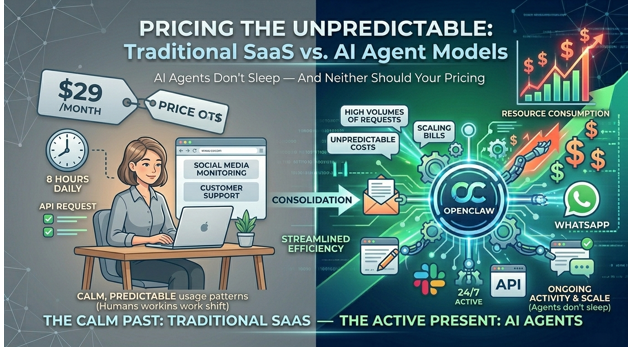
SaaS pricing was designed for humans who sleep, take weekends off, and forget to log in. AI agents do none of those things.
Google started banning users earlier this year. Not for violating terms of service in any traditional sense. For using a product too much.
The users in question had connected OpenClaw – the open-source AI agent framework with 230,000+ GitHub stars – to Google’s Antigravity backend. Their agents were making requests 24 hours a day, 7 days a week, at a volume that no human user would ever generate. Google’s infrastructure buckled. The bans followed.
OpenClaw’s own newsletter captured the core issue perfectly: “AI subscriptions were priced for humans. OpenClaw exposed the flaw.”
That sentence should worry every SaaS founder reading this. Because the pricing model that supports most of the software industry – flat-rate monthly subscriptions – was built on an assumption that’s about to collapse.
The Hidden Assumption Behind Every $29/Month Plan
Here’s how SaaS pricing actually works, stripped of all the positioning.
You charge a flat monthly fee. You model your costs based on average usage patterns. Those patterns are human patterns: a user logs in a few times a day, performs some actions, and logs out. They sleep for eight hours. They take weekends. They go on vacation. They forget about your product for weeks and then come back.
The math works because most users don’t use most of what they’re paying for, most of the time. The light users subsidize the power users. The churn you hate actually helps your margins. And the average cost to serve each customer stays well below the subscription price.
Now put an AI agent in that seat.
An OpenClaw agent doesn’t sleep. It doesn’t take weekends. It doesn’t forget to log in. It runs a continuous loop – perceive, think, act, reflect – and it will hit your API endpoints, consume your compute resources, and process data at a pace that makes your heaviest human power user look idle.
A single agent running common automation workflows can generate 10-50x the API calls of a typical human user. And it does it every single day, without pause.
But that’s not the real problem.
The Arbitrage Nobody Saw Coming
The real problem is that AI agents create a new kind of economic arbitrage in SaaS.
Consider a practical example. A startup pays $89/month for a social media monitoring tool. That tool was priced assuming a human would check it a few times daily, scan some dashboards, and maybe set up some alerts. The cost to serve that customer: maybe $3-5/month in infrastructure.
Now that startup deploys an OpenClaw agent that monitors the same social channels continuously, pulling data through the tool’s API every few minutes, drafting responses, cross-referencing with CRM data, and acting on results automatically. The cost to serve jumps to $40-60/month. The subscription price stays at $89.
The margin just collapsed from ~95% to ~30%. And the SaaS company doesn’t even know why their infrastructure costs are spiking.
Multiply this across thousands of users deploying agents – and with OpenClaw’s 44,000+ forks, that’s already happening – and you have a structural problem that flat-rate pricing can’t absorb.
Managed OpenClaw hosting platforms like Better Claw are seeing this play out in real time. Their users deploy AI agents that connect to multiple SaaS tools simultaneously, running workflows that hit external APIs at volumes those tools never anticipated. The agent hosting infrastructure is designed for this load. The downstream SaaS tools are not.
See also: How to Build a Productive Morning Routine for College Success
Three Pricing Models That Actually Work for Agents
So what replaces the flat-rate subscription? Three models are emerging.
1. Usage-based pricing (the obvious answer). Charge per API call, per compute minute, or per action. This aligns costs with actual consumption, whether the user is human or machine. The downside: unpredictable bills make customers nervous. And agents can generate surprisingly large invoices – which is why Google banned users rather than just billing them more.
2. BYOK (Bring Your Own Key). This is where it gets interesting. Instead of bundling AI compute into the subscription, separate the infrastructure layer from the intelligence layer. Users bring their own API keys for LLM providers (OpenAI, Anthropic, Google) and pay those providers directly for usage. The platform charges a flat fee for infrastructure, security, and management – not for compute.
This model is gaining traction specifically in the OpenClaw ecosystem. The most popular OpenClaw agent use cases – customer support, social monitoring, lead qualification, content workflows – all involve variable AI compute depending on volume. BYOK lets the infrastructure price stay flat and predictable while the variable compute cost flows directly to the model provider, who is actually built to handle usage-based billing at scale.
3. Tiered agent-aware pricing. Create separate tiers for human users and agent/API users, with different rate limits and pricing. This is what Salesforce, HubSpot, and several enterprise platforms are beginning to explore – though most are still early in the implementation.
Why BYOK Is Winning the Agent Infrastructure Market
Stay with me here, because the BYOK model reveals something important about where software economics is heading.
The traditional SaaS bundle – pay one price, get everything – works when usage is relatively uniform and predictable. The moment agents enter the picture, usage becomes wildly variable. One customer’s agent might make 500 API calls a day. Another’s might make 50,000. Charging both the same flat rate is economically unsustainable.
BYOK unbundles the stack. The infrastructure provider handles deployment, security, monitoring, and uptime – things with relatively predictable costs. The AI compute – the expensive, variable part – flows directly to the model provider through the user’s own API key.
This is why the managed OpenClaw market has converged on BYOK as the default model. ClawHosted charges $49/month with BYOK. xCloud charges $24/month with BYOK. BetterClaw’s agent hosting starts at $19/month, also BYOK. The infrastructure fee is flat and predictable. The AI compute scales with actual usage but gets billed separately by the model provider.
For the user, this means total cost transparency. You know exactly what you’re paying for hosting ($19-49/month) and you can see exactly what your agent is consuming in API tokens (typically $5-30/month for common workflows, potentially more for high-volume use cases).
For the infrastructure provider, it means sustainable margins regardless of how heavily any individual agent runs. They’ve neatly sidestepped the “agent arbitrage” problem that’s about to hit flat-rate SaaS companies.
What This Means If You’re Building SaaS
If you’re a SaaS founder or product leader, the implications are direct:
Audit your API rate limits. If you offer an API – and most SaaS products do – check whether your current rate limits can absorb agent-level traffic. The OpenClaw project has 230K+ stars. Your users are going to connect agents to your product. Plan for it.
Model your unit economics with agent users. Take your heaviest human power user. Multiply their usage by 20. That’s your floor for agent consumption. If your margins can’t survive that multiplier at your current price point, you have a pricing problem waiting to surface.
Consider hybrid pricing. Keep flat-rate for human users (they expect it, and it works). Add usage-based or tiered pricing for API/agent access. This isn’t unprecedented – Slack, Notion, and others already differentiate between human and bot users in their pricing.
Watch the BYOK pattern. If the AI agent infrastructure market has already rejected bundled compute pricing in favor of BYOK, that signal is worth paying attention to. Your customers may eventually expect the same unbundled transparency from your product.
The Pricing Reset Is Coming
Every major technology shift forces a pricing reckoning. Cloud computing killed per-seat server licenses. Mobile killed paid desktop software. Streaming killed per-unit media sales.
AI agents are about to do the same thing to flat-rate SaaS subscriptions. Not because the subscription model is bad – it’s served the industry brilliantly for 15 years. But because it was designed for a world where your customer was a person with limited hours and attention.
That world is ending. Your next power user won’t sleep, won’t churn, and won’t underuse your product. It will consume everything you included in that $29/month plan, every single day, and ask for more.
The companies that re-architect their pricing before the agents arrive will be fine. The ones that wait until their margins tell them something is wrong will be playing catch-up.
The pricing conversation isn’t about AI agents specifically. It’s about what happens when your customer isn’t human anymore. Every business model assumption downstream of that question is up for review.